

THERE WERE MANY who believed that it was the beginning of the end for the Enron class action litigation when in June of this year JPMorgan Chase & Co. paid US$2.2 billion to the energy trader's large investors, led by the University of California and a host of American pension funds. Then, when Citigroup Inc. followed suit with another $2 billion, surely the final chapter was being written.
These were, after all, huge settlements by major US financial institutions to large institutional plaintiffs in multi-party US litigation. Who would have thought there was even bigger news to come? And among those who did, who imagined it would come from Canada? But come it did.
In early August, the Canadian Imperial Bank of Commerce (CIBC), the nation's fifth largest financial institution and owner of CIBC World Markets, agreed to pay US$2.4 billion to resolve claims that it took part in the alleged scheme to defraud Enron investors. The settlement, more than the entirety of the bank's profits in 2004, was the largest payment in the litigation to date. The $2.4 billion was 10 times the reserve the bank had set aside.
Within two weeks, the bank's shares fell 12 per cent. Roy Elliott Kim O'Connor LLP (REKO), a Toronto litigation boutique, promptly announced preparations for a multi-billion class action suit against CIBC and its board.
CIBC wasn't the only Canadian financial institution contributing to the Enron settlement. The Toronto-Dominion Bank paid $130 million and the Royal Bank of Canada paid $25 million.
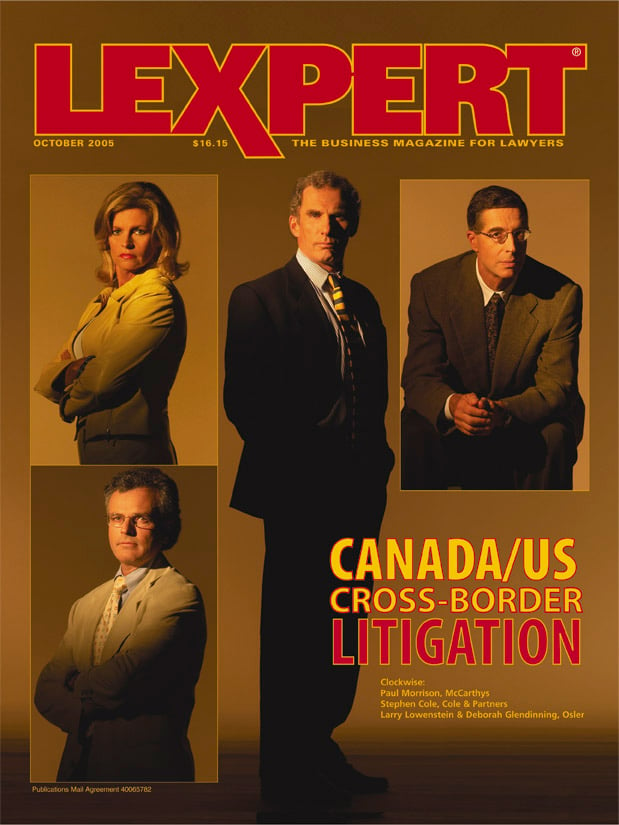
Paul Morrison, a senior litigator at McCarthy Tétrault LLP in Toronto, does not mince words when describing the state of US/Canada cross-border litigation. “Canada is in the gun sights of American class action lawyers much as the United States has been in the gun sights of Canadian lawyers since Ontario enacted the Class Proceedings Act in 1993.”
Large targets are frequently caught in these gun sights. The Canadian and American versions of the multiple civil suits and regulatory proceedings against the various components of Conrad Black's Hollinger publishing empire, for example, are clearly intertwined. As noted by J.L. McDougall, Q.C., at Fraser Milner Casgrain LLP, “The Hollinger class action in Canada is a dead-to-rights copy of the American action, although not a very good one in the Canadian context.”
And the $253 million awarded by a Texas jury this August following the first Vioxx trial has, to say the least, caught the attention not only of potential and existing plaintiffs in the 100,000 or so US lawsuits extant and expected against Merck, but also the attention of the plaintiffs in 30 class action lawsuits commenced in Canada. “Cross-border product liability class actions have become a fact of life in Canada,” notes Barry Leon, a litigation partner in the Toronto office of Torys LLP.
AS EXPLAINED BY STAN WONG of Davis & Company LLP in Vancouver, much the same is happening in competition class actions. “Once there's an inkling of a government investigation in the United States, somebody starts a class action. Increasingly, a Canadian action follows very quickly.”
US attorneys echo Wong's view. “It is a significant understatement to say that Canada is on
the horizon of US plaintiffs' class action counsel,” says Michael Freed of Much Shelist Freed Denenberg Ament & Rubenstein, P.C., in Chicago. “The partnership between Canadian and American plaintiffs' attorneys is much more advanced than that.”
As a result of this “interrelationship,” the services of professionals in fields such as damage quantification, class size estimation, participation rate determination and class action judgment or settlement administration are being geared to both countries. As Eric Khan of Deloitte & Touche LLP in Toronto points out, “It's becoming more and more important to have expertise on both sides of the border.”
It thus comes as no surprise that the American Trial Lawyers' Association Conference, held in Toronto in July, was well attended by plaintiffs' attorneys from the US. As noted by Won Kim of REKO, “There was a whole contingent of US litigators intent on pinning down the Canadian players.”
As usual, Harvey Strosberg, Q.C., of Sutts Strosberg LLP in Windsor, arguably the leading Canadian plaintiffs' class action counsel, was a step ahead. Somehow he ended up having dinner at the New York home of his American counterpart Melvyn Weiss of Milberg Weiss Bershad & Schulman LLP. Weiss is plain-spoken about his interest. “I've been following the Canadian class action scene closely.” For his part Strosberg, unusually circumspect, will say only that he “enjoyed the conversation and the artwork.”
Fireside chats aside, more formal relationships are developing. Lieff Cabraser Heimann & Bernstein, LLP, a well-known plaintiffs' firm in the US, has established an “affiliate counsel” relationship with Rochon Genova LLP in Toronto. This association has led to parallel securities actions against Nortel Networks. “Globalization means that corporate malfeasance transcends national borders,” says name partner Joel Rochon. “It's time for the plaintiffs' bar to address this.”
By all accounts they're doing just that.
“The percentage of class proceedings that are copycat actions is going up,” notes Deborah Glendinning of Osler, Hoskin & Harcourt LLP in Toronto. Glendinning, with colleague Lyndon Barnes, is defending the Canadian version of the US tobacco litigation. Copycat actions are thriving elsewhere in Canada. “My estimation is that US-related class actions constitute one-third of all class action proceedings in Vancouver,” says Brad Dixon of Borden Ladner Gervais LLP (BLG). Dixon keeps a close eye on the court registry.
In the most recent high-profile example of intervention by US plaintiffs' firms, Mary Schiavo, a partner at Motley Rice which made its reputation in the asbestos litigation, was in Toronto and on local television within days of the August 2, crash of Air France Flight 358 at Toronto's International Airport. By August 5, Toronto-based Will Barristers: Morin & Miller had filed suit in the Ontario Superior Court. The Motley Rice website has “Motley Rice and co-counsel Will Barristers” as the plaintiffs' lawyers in the litigation.
American plaintiffs' counsel are not shy about their activities in Canada. As somewhat sarcastically pointed out by John Campion, a leading defence litigator with Fasken Martineau DuMoulin LLP in Toronto, “Sometimes I get a sense that American plaintiffs' counsel are suffering from the quaint illusion that they can argue the Canadian case themselves.” Indeed. Lieff Cabraser has already indicated that they are prepared to seek occasional calls to the Ontario Bar when necessary.
ODDLY, THE CROSS-BORDER DEFENCE bars seem less integrated. As noted by Alan Lenczner of Toronto-based Lenczner Slaght Royce Smith Griffin LLP, “I don't know whether it's ego or jealousy or just laziness, but defence lawyers continue to be slow off the mark to communicate with each other.”
As the debacle over insurance defence settlements, on behalf of Hollinger's independent directors to the exclusion of the company's, has demonstrated, a lack of attention to cross-border issues means the growth of parallel securities class actions may rob defendants of finality, the one benefit class actions clearly provide to defendants.
Adding complexity to the jurisdictional issue is Currie v. McDonald's Restaurants of Canada Ltd., the Ontario Court of Appeal decision that recognizes that Canadian plaintiffs may be bound by a US class action judgment or settlement. Currie imposes relatively onerous notice requirements on American defendants attempting to enforce such judgments or settlements. As pointed out by Joe Groia of Groia & Company Professional Corp., “There's only so much money available to settle all claims and courts on both sides of the border will be careful to ensure that nobody finds themselves out in the cold.”
In large part, all of this is the result of the enormous cross-border commerce between the United States and Canada. As the two economies merge, so does the litigation, creating a complicated jurisdictional and procedural maze that has heightened, rather than dampened, the enthusiasm and cooperation between plaintiffs' firms on both sides of the borders.
As pointed out by Robert Armstrong in the Toronto office of Ogilvy Renault LLP, “The number one trend in Ontario is an attempt to leverage US class action lawsuits using the same factual and expert evidence upon which the American action is based.” It's a development that is surfacing across Canada. “I've enjoyed a considerable measure of success in working with US counsel,” says J.J. Camp, Q.C., of Camp Fiorante Matthews, a top-ranked Vancouver-based litigation boutique.
US courts have done little to discourage this development. “I've been surprised at how willing US courts were to allow Canadian plaintiffs access to discovery from US cases,” Paul Morrison says, citing the decision of the US Supreme Court in Intel v. AMD.
So even as the recently enacted Class Action Fairness Act (CAFA)—which moves most class actions from plaintiff friendly state courts to federal courts—threatens to dampen class action enthusiasm in the US, cross-border class actions show no signs of abating in Canada. “I continue to see many product liability cases that are simple copies of what's going on in the US,” says James Hodgson of Hodgson Shields DesBrisay O'Donnell LLP in Toronto.
It wasn't that long ago, however, that it was defendants and their lawyers who were doing the cheering. After all, securities class actions, especially strike suits, and tobacco-related suits—two bugbears of the US system—were all but dead in Canadian waters.
THE FIRST VENTURES by Canadian plaintiffs' counsel into American-style “strike suits” can only be described as disastrous. Much of the credit goes to a tenacious group of defence lawyers who recognized that the US experience did not necessarily have to be the Canadian one.
In the most egregious case, David Klein of Vancouver-based Klein Lyons, with the assistance of Milberg Weiss, brought a class action attacking the National Bank of Canada's merger with First Marathon Inc. About the same time Ward Branch and James MacMaster of Vancouver-based Branch MacMaster, working with US-based Beattie & Osborn LLP, mounted an almost identical assault on the BAT plc purchase of Imasco Limited.
Similarly, in what was technically a derivative claim on the class action strike suit model, Klein, again with assistance from Milberg Weiss, complained that the price achieved by International Comfort Products Corporation (ICP) in the context of a takeover by Titan Acquisitions Ltd. (Titan) was inadequate.
All three actions failed miserably. In ICP a team at Osler, led by Larry Lowenstein, and David Byers at Stikeman Elliott LLP achieved a settlement dismissing the action without costs. In Stern v. Imasco a team again at Osler, led by Lyndon Barnes, joined forces with David Byers and Katherine Kay at Stikemans. Together with Joseph Groia they convinced Ontario Superior Court Justice Peter Cumming that the claim against BAT and the directors of Imasco disclosed no cause of action.
At that point, it appears, Justice Cumming had seen quite enough of strike suits. When Klein subsequently asked Cumming to approve a settlement in Epstein v. First Marathon that would have paid $190,000 to his firm and nothing to the class, Cumming refused notwithstanding that all parties had consented. Justice Cumming then dismissed the class action on the basis that there was “to be no payment of any monies to Klein Lyons, under the Settlement Agreement or otherwise, as a consequence of the dismissal of the action.”
Judicial disapproval, Justice Cumming reasoned, was the only tool available for dealing with the proliferation of strike suits, which he described as “a class proceeding that is properly regarded as an abuse of process.”
THE DEMISE OF STRIKE SUITS occurred almost simultaneously with the decimation of the massive Bre-X securities class action. Not long after the gold miner collapsed amidst allegations of fraud, a few enterprising Canadian lawyers, relying on their newfound ability to launch class actions, sued everyone in sight. Defendants included brokers who had promoted the stock, including BMO Nesbitt Burns and Scotia McLeod, Bre-X and related companies, company insiders and professional firms, including engineering giant SNC Lavalin.
Realistically, the primary targets were defendants with deep enough pockets to pay the costs for losses relating to a company whose market capitalization had reached $6 billion. Success against the brokers, and to a lesser extent the insiders, was critical.
It was not to be. The class action suit was launched in 1997. By 2000, the courts had cut the brokers loose and severely restricted the lawsuits against the insiders. Unified class actions, the courts decided, were not an appropriate vehicle for complicated lawsuits involving a grab bag of negligent misrepresentations made on an individual basis by numerous brokers to numerous investors.
The plaintiffs applied for leave to appeal the restrictive certification decision. But, soon afterwards the investors' lawyers, who were mired in political infighting, advised their clients to abandon the appeal against the brokers in return for payment of their legal costs. Because the settlement was subject to a confidentiality agreement its exact cost is not known. Suffice it to say the defendants and their lawyers were delighted. “I'm not sure the Bre-X decisions made sense, but they sure were a huge win for brokerage houses and insiders,” recalls one Toronto litigator, speaking off the record, whose firm represents brokers and insiders.
And in two unrelated cases decided in 2002, Ontario Superior Court Justice Ian Nordheimer upped the stakes for class action plaintiffs whose certification motions failed. In Gariepy v. Shell Oil, a product liability claim that Shell's polybutylene plumbing had damaged the plaintiffs' homes, Nordheimer required the plaintiffs to pay $112,000 in legal fees to the defendants. In Pearson v. Inco, where the plaintiffs alleged that Inco had polluted the soil around Port Colborne, Ontario, Lowenstein convinced Nordheimer to make the plaintiffs pay $118,000 in legal fees.
Previously the highest costs award against plaintiffs in class action proceedings had been $15,000. According to Lowenstein, “Inco was a case that tried to import Erin Brockovich from the United States. The result was a disaster for the plaintiffs.” To say that defendants were on a roll would have been a considerable understatement.
THE COUP DE GRÂCE came in February 2004, when Lyndon Barnes and Deborah Glendinning, and their co-counsel, convinced Justice Warren Winkler of the Ontario Superior Court not to certify the class in Caputo, known as the “tobacco case.” It marked the culmination of a decade of proceedings which, with a potential class of millions of Canadians, closely resembled the mammoth tobacco litigation in the United States.
Winkler focused on the failure of the plaintiffs to come up with a litigation plan that reflected the sheer scope of the case. As explained by Glendinning, “What the court was saying is that establishing a few common issues doesn't give plaintiffs a free ride to certification anymore.”
Without a doubt, Caputo was a huge defeat for so-called “copycat” actions. It sent the plain message that certification or settlement in the US was not an instant formula for success in parallel actions in Canada.
But Caputo may also have been the high-water mark for defendants. In the 18 months between Winkler's decision in Caputo and press time, the pendulum has been slowly swinging in the other direction.
And come 2006 the pace is sure to accelerate. 2006 is when Ontario's long-awaited Bill 198 becomes law. “As far as securities class actions are concerned, we're at a very fluid moment in time,” cautions Nigel Campbell of Blake, Cassels & Graydon LLP.
Bill 198 gives secondary market shareholders the right to bring class actions for disclosure violations without having to prove reliance by individual investors on the false statements.
The legislation imports the American doctrine of “fraud on the market” meaning that the secondary market class actions, which are a mainstay in the US, promise to be a fruitful source for copycat proceedings in Ontario. Importantly, Ontario is home to 90 per cent of Canada's public market transactions.
The anticipated litigation is such that Stikeman Elliott has named its comprehensive guide to the new legislation Litigation Unleashed. The Guide's cover features a thunderous sky punctuated by lightning bolts. As explained by Alan D'Silva at Stikemans, “The good securities cases that have had some success in the United States will now be litigated up here as well.” All the more so, notes Joel Richler at Blakes, because the test for certifying such class actions in Ontario is arguably less onerous than the test in the US.
According to Markus Koehnen, a commercial litigator at McMillan Binch Mendelsohn LLP, Bill 198 represents a “tremendous opportunity for Canadian lawyers.” Fritz Jekel of Motley Rice in the US maintains that it is an opportunity that the plaintiffs' bar won't miss. “The most important development in Canada is that Canadian plaintiffs' lawyers have become a lot smarter about how to frame class actions so that they'll be certified.”
To be sure, Bill 198 requires plaintiffs to obtain leave before commencing an action. They must satisfy the court that the action is brought in good faith and that there is a “reasonable possibility” that it will succeed at trial.
But these requirements may prove to be cold comfort for defendants. Lowenstein is of the view that “the test on the leave application represents a very low threshold.” Ironically, Paul Pape, a prominent Toronto plaintiffs' lawyer, holds the opposite view. “Because the leave application is merits based, the defence can litigate it to death before the claim is even issued.”
In any event defendants will take some comfort from Bill 198's damage cap, which may make some cases uneconomical for plaintiffs' counsel. A company's liability may not exceed the greater of C$1 million or 20 per cent of its market capitalization. There are also limits on the liability of individuals and on experts who contributed to the false statements in question. But, because there is no cumulative limit on damages, Bill 198 may encourage plaintiffs to sue as many deep-pocketed parties as possible.
British Columbia has similar draft legislation. While BC is home to nowhere near the cross-border securities transactions that Ontario is, plaintiffs filing against companies with connections in both jurisdictions may find BC more attractive because, unlike Ontario, it has no “loser pays” costs rule.
According to William Horton at Blakes, the greatest challenge facing defendants under Bill 198 will be the uncertainty. “In the United States there is almost a predictability within a range as to what a class action will settle for relative to the amount claimed. You don't have that in Canada where securities class actions have been rare so far.”
THE BROUHAHA OVER BILL 198 is more than speculation. Indeed plaintiffs' lawyers have carefully set the stage for Bill 198, most notably in Kerr v. Danier, which is currently on reserve by the Ontario Court of Appeal.
Danier was the first judgment ever under the 30-year-old section 130 of the Ontario Securities Act. This provision provides a right of action to investors who have sustained losses as a result of misrepresentations in a prospectus. While section 130 gives no rights to secondary market traders, Justice Sidney Lederman's ruling, if upheld on appeal, could have a significant impact on subsequent Bill 198 decisions.
To begin with, Danier changes Canadian law on the duties of directors and officers involved in an initial public offering bringing it in line with American jurisprudence. “Section 130 is virtually identical to section 11 of the US Securities Act, which American courts have interpreted repeatedly,” notes George Glezos of Lerners LLP, co-counsel for the plaintiffs. “What Danier demonstrates is that Canadian courts will look to American precedents in cases of prospectus misrepresentation.”
There is no question that Justice Lederman's decision in Danier is not good news for defendants. “Danier is a huge case, a template case from the perspective of liability for directors and officers,” Lowenstein notes. “D&O insurers should be reading it closely.”
Much of the difficulty lies in Lederman's finding that the executives at Danier were liable despite lacking the intention to mislead. Rather, they were liable because their decision not to disclose certain facts was unreasonable, at least in hindsight, at the time they made it.
Making matters worse for defendants, Danier provides a workable formula for calculating damages in securities cases. “This is the first time a Canadian court has evaluated the losses arising from a misrepresentation under the Securities Act,” says Peter Jervis of Lerners, co-counsel with Glezos. “The elegance and simplicity of the damage calculation by the court provides a consistent measure of damages that will make these cases much easier to try.”
The result will be a greater risk factor for companies seeking public financing, one that Alan Lenczner believes is untenable in a viable capital market: “The investment community has told me that that they can't make a move now without dancing on the head of a pin.”
On the other hand, dancing on the head of a pin is what many defendants' counsel have been doing to ward off class actions. “Class action defendants have been successful in using certain tactics to slice and dice cases so as to litigate them in serial rather than parallel fashion,” argues Michael McGowan of McGowan & Company.
This is at least part of the reason why Glendinning and her colleagues managed to delay the certification motion in Caputo for almost 10 years, in stark contrast to the US where class actions move along more quickly. “The Ontario legislature designed certification as a very simple process based on the pleadings,” says Joel Rochon. “Instead it has become a monstrous undertaking involving motions that throw class actions into a tailspin.”
Following the Supreme Court of Canada's 2004 decision in Garland v. Consumer Gas, however, those days may be over. In other words, corporate defendants in the US may no longer be able to rely on the fact that class actions against them in Canada can easily be stalled until they resolve the parallel US litigation.
Ten years after Gordon Garland filed a class action suit against Consumers Gas Company Limited (now Enbridge) seeking repayment of hundreds of million of dollars in late penalty charges, the case reached the Supreme Court of Canada. For the second time.
In Garland #1 the Supreme Court ruled that Enbridge had violated the excessive interest provisions of the Criminal Code. With no facts in dispute, both parties then brought cross-motions for summary judgment in the Ontario Superior Court. Eventually, the case reached the Supreme Court again as Garland #2. This time the court ordered the gas company to repay consumers to the extent that the company's “late charges” exceeded the limits set in the Criminal Code, an amount estimated at C$100 million. The court returned the matter to the motions judge to deal with certification and assessment of damages. “Here we are, a decade after the fact, and it's only now that we're going to deal with certification,” notes McGowan, who represented Garland.
Defendants, however, may be loath to employ such tactics in the future. It cost them dearly in Garland. Using strong language, the court granted the plaintiff “costs throughout.” It expressly disapproved of the “installment” approach to class action litigation that favours deep-pocketed defendants.
Even more ominous, however, is the Supreme Court's finding that the overriding public policy in the case prohibited Enbridge from keeping the proceeds of its crimes. Coincidentally, or perhaps not, an Ontario judge thought the same way about manufacturers keeping money received from the sale of defective products.
According to Paul Pape, co-counsel to the plaintiff, “When Serhan v. Johnson & Johnson is approved and tried and judgment rendered, it will streamline much greater access to class actions.”
The reason is simple. Johnson, which involves home-testing kits for diabetics, validates “waiver of tort” as a cause of action in Ontario. Waiver of tort, an unjust enrichment concept, requires defendants to disgorge revenues garnered from defective products. This relieves plaintiffs of the need to prove individual damages which, so far, has been the biggest obstacle to certification in product liability cases. As Pape goes on to explain, “Judges have been reluctant to certify common issues when there are many more miles to go in proving individual damages.”
Indeed, Superior Court Justice Maurice Cullity certified the class in Serhan despite an absence of evidence that any class member suffered health problems or economic loss. Ironically, neither of the lead plaintiffs had even paid for the defective device, which was covered by the public drug benefits program in Ontario.
Cullity also took a liberal approach to waiver of tort. As explained by Doug Harrison at Stikeman Elliott, “Waiver of tort typically applies only when you're dealing with a fiduciary or contractual relationship, but Cullity drives a truck through that loophole. This could be one of the most important product liability cases we've ever had in Canada. It also opens the door to punitives if the defendant's behaviour is egregious enough.”
In terms of cross-border product liability cases, this all translates very simply: there will be a great deal more incentive to bring them.
To be sure, there is reason to doubt the correctness of Cullity's decision. As Justice John Ground noted in granting an application for leave to appeal brought by Michael Barrack of McCarthy Tétrault, counsel to Johnson & Johnson, it's unclear whether waiver of tort is a standalone cause of action or a choice of remedy by a plaintiff who has established an actionable wrong.
Still, it's not hard to see why Harvey Strosberg, co-counsel with Pape, is so enthusiastic about Johnson. “The case is a missile in our arsenal.” Pape agrees. “If there's any colourable conduct beyond mere negligence, the ways in which waiver of tort can be applied are limited only by counsel's imagination.”
The impact of these developments could be significant. Nine of Canada's 10 provinces now have class action legislation (Prince Edward Island, the smallest province, does not), compared to just three provinces (Quebec, Ontario and British Columbia) four years ago. And although the six latecomers have much smaller populations and economies, there are already clear signs that the plaintiffs' bar in these provinces have grand designs.
“The enactment of class action legislation throughout the country has people vying for turf,” explains Kent Thomson of Davies Ward Phillips & Vineberg LLP. “That's just going to make the plaintiffs' class action bar stronger.” Katherine Kay at Stikeman Elliott agrees. “Once somebody says, ‘Hey, Toronto, you're not the centre of the universe,' you have the makings of a real jurisdictional mess.”
STIRRING THE POT IS Tony Merchant, Q.C., of Merchant Law Group in Regina, Saskatchewan. At press time Merchant was preparing for a September motion in the Ontario Superior Court where he has applied for carriage of the Canadian Vioxx litigation. Paul Morrison at McCarthys is of the view that “Merchant just throws out claims in various provinces in the hope of getting some of the action. He's like a mining prospector who's putting stakes in the ground.”
Merchant is unapologetic. “We're seeing a tug of war between east and west for control of class actions. Ontario lawyers are especially galling. If something happens in Ontario they think it should bind Medicine Hat (in Saskatchewan) and Inuvik (in the far north). And they don't give much thought to the fact that it takes four years to get a trial date in Toronto. Manitoba, with a class action regime that has no costs, easy certification and opt-out provisions for national classes, is also attracting attention. As Won Kim notes, “Manitoba has targeted class actions like Delaware has targeted corporations.” Kim's firm, REKO, is considering opening an office in Winnipeg.
For his part, Merchant has already opened in five provinces. Importantly, the strategy employed by Merchant may herald the arrival of national plaintiffs' class action law firms who, in turn, could hook up with their US counterparts in the hope of acquiring continental clout. “You're going to find more and more boutiques setting up across the country,” predicts Malcolm Ruby, a class action partner with Gowling Lafleur
Henderson LLP.
One of their favourite places will undoubtedly be the Province of Quebec. Quebec enacted class action legislation in 1978, some 15 years before Ontario, the second province to do so. However, for the first 20 years or so the vast majority of cases were local proceedings unique to the Quebec environment. But when Ontario and British Columbia (1995) enacted class action legislation, Quebec litigation developed a broader national base, followed quickly by a cross-border base.
It wasn't long before the Quebec judiciary became known for a liberal approach to certification. “Quebec's courts don't seem to think that they have a duty as gatekeepers,” says Vincent O'Donnell, Q.C., a senior litigator with Montreal-based Lavery, de Billy LLP.
Neither, apparently, did the Quebec legislature. In 2003 it changed the class action rules by removing the requirement for plaintiffs to file any affidavit material in support of
certification. In April of this year, the Quebec Court of Appeal upheld the constitutionality of the measure in Pharmascience Inc. v. Options Consommateurs et Piro.
As Jean Saint-Onge, O'Donnell's partner, points out, “Since the legislature made class action rights easier to exercise, there has been a significant increase in all areas, with financial institutions, retail and pharmaceuticals being the sectors that have been hit the hardest. And in many instances these cases originate in the United States.”
The liberal and inexpensive certification procedure, then, means that Quebec could well be becoming a proving ground for copycat actions. “Everybody will rush to the jurisdiction that is the most favourable,” says Rob Bell of BLG. The difficulty for plaintiffs, and the advantage for defendants, is that Quebec judges have been reluctant to certify national classes. And, as Paul Morrison points out, “When it comes to jurisdiction, no one knows what Canadian courts will come up with to resolve provincial conflicts.”
Meanwhile, the pendulum continues to tilt against defendants. In March of this year, about one year after Justice Winkler refused certification in Caputo, the defence team from Osler asked him to impose C$1.2 million in costs against the three representative plaintiffs in Caputo, including a shoe repairman and a lunchroom supervisor. In the alter-native, the defendants sought payment of the costs from plaintiffs' counsel.
Winkler refused. He criticized both plaintiffs' and defendants' counsel for relying on merits directed evidence that increased the cost of the certification motion. He also noted that Caputo was not a test case in the sense that it would govern similar actions. He did note, however, that Caputo raised novel legal issues and had a “strong public interest component.”
IT WASN'T HARD to read between the lines. While Winkler, arguably the most influential Canadian jurist in class action proceedings, wasn't prepared to certify Caputo, neither was he prepared to discourage future plaintiffs or, perhaps more importantly, their lawyers.
In short order it became clear that they weren't going to be discouraged at all. Just one day after Winkler's decision Justice Cullity dismissed the defendant's motion for summary judgment in Ragoonanan v. Imperial Tobacco, a suit based on the company's alleged failure to manufacture “fire-safe” cigarettes for its customers. At press time the certification motion, now free of the argument that no valid cause of action exists, was scheduled for September.
So the tobacco case, a major piece of the cross-border action, lives on. This doesn't surprise on, lives on. This doesn't surprise Fritz Jekel at US-based Motley Rice. “Canada is not a small place and Canadians are a lot like Americans in that they buy a lot, they worry about consumer rights a lot, and they believe that people who have been harmed should be compensated.” He might have gone on to add, “And, like Americans, they're starting to sue a lot.”
Jekel will get no argument from the defence bar. As Katherine Kay at Stikeman Elliott concludes, “Ten years ago no one thought of big ticket litigation as a cost of doing business, but that's changed, and in a very short time. Businesses now understand that they are likely to be involved in class action activity. It's still a pain in the butt, but no one disputes that it has become a real cost of doing business in Canada.”
Julius Melnitzer is a Toronto-based freelance legal affairs writer.
These were, after all, huge settlements by major US financial institutions to large institutional plaintiffs in multi-party US litigation. Who would have thought there was even bigger news to come? And among those who did, who imagined it would come from Canada? But come it did.
In early August, the Canadian Imperial Bank of Commerce (CIBC), the nation's fifth largest financial institution and owner of CIBC World Markets, agreed to pay US$2.4 billion to resolve claims that it took part in the alleged scheme to defraud Enron investors. The settlement, more than the entirety of the bank's profits in 2004, was the largest payment in the litigation to date. The $2.4 billion was 10 times the reserve the bank had set aside.
Within two weeks, the bank's shares fell 12 per cent. Roy Elliott Kim O'Connor LLP (REKO), a Toronto litigation boutique, promptly announced preparations for a multi-billion class action suit against CIBC and its board.
CIBC wasn't the only Canadian financial institution contributing to the Enron settlement. The Toronto-Dominion Bank paid $130 million and the Royal Bank of Canada paid $25 million.
Paul Morrison, a senior litigator at McCarthy Tétrault LLP in Toronto, does not mince words when describing the state of US/Canada cross-border litigation. “Canada is in the gun sights of American class action lawyers much as the United States has been in the gun sights of Canadian lawyers since Ontario enacted the Class Proceedings Act in 1993.”
Large targets are frequently caught in these gun sights. The Canadian and American versions of the multiple civil suits and regulatory proceedings against the various components of Conrad Black's Hollinger publishing empire, for example, are clearly intertwined. As noted by J.L. McDougall, Q.C., at Fraser Milner Casgrain LLP, “The Hollinger class action in Canada is a dead-to-rights copy of the American action, although not a very good one in the Canadian context.”
And the $253 million awarded by a Texas jury this August following the first Vioxx trial has, to say the least, caught the attention not only of potential and existing plaintiffs in the 100,000 or so US lawsuits extant and expected against Merck, but also the attention of the plaintiffs in 30 class action lawsuits commenced in Canada. “Cross-border product liability class actions have become a fact of life in Canada,” notes Barry Leon, a litigation partner in the Toronto office of Torys LLP.
AS EXPLAINED BY STAN WONG of Davis & Company LLP in Vancouver, much the same is happening in competition class actions. “Once there's an inkling of a government investigation in the United States, somebody starts a class action. Increasingly, a Canadian action follows very quickly.”
US attorneys echo Wong's view. “It is a significant understatement to say that Canada is on
the horizon of US plaintiffs' class action counsel,” says Michael Freed of Much Shelist Freed Denenberg Ament & Rubenstein, P.C., in Chicago. “The partnership between Canadian and American plaintiffs' attorneys is much more advanced than that.”
As a result of this “interrelationship,” the services of professionals in fields such as damage quantification, class size estimation, participation rate determination and class action judgment or settlement administration are being geared to both countries. As Eric Khan of Deloitte & Touche LLP in Toronto points out, “It's becoming more and more important to have expertise on both sides of the border.”
It thus comes as no surprise that the American Trial Lawyers' Association Conference, held in Toronto in July, was well attended by plaintiffs' attorneys from the US. As noted by Won Kim of REKO, “There was a whole contingent of US litigators intent on pinning down the Canadian players.”
As usual, Harvey Strosberg, Q.C., of Sutts Strosberg LLP in Windsor, arguably the leading Canadian plaintiffs' class action counsel, was a step ahead. Somehow he ended up having dinner at the New York home of his American counterpart Melvyn Weiss of Milberg Weiss Bershad & Schulman LLP. Weiss is plain-spoken about his interest. “I've been following the Canadian class action scene closely.” For his part Strosberg, unusually circumspect, will say only that he “enjoyed the conversation and the artwork.”
Fireside chats aside, more formal relationships are developing. Lieff Cabraser Heimann & Bernstein, LLP, a well-known plaintiffs' firm in the US, has established an “affiliate counsel” relationship with Rochon Genova LLP in Toronto. This association has led to parallel securities actions against Nortel Networks. “Globalization means that corporate malfeasance transcends national borders,” says name partner Joel Rochon. “It's time for the plaintiffs' bar to address this.”
By all accounts they're doing just that.
“The percentage of class proceedings that are copycat actions is going up,” notes Deborah Glendinning of Osler, Hoskin & Harcourt LLP in Toronto. Glendinning, with colleague Lyndon Barnes, is defending the Canadian version of the US tobacco litigation. Copycat actions are thriving elsewhere in Canada. “My estimation is that US-related class actions constitute one-third of all class action proceedings in Vancouver,” says Brad Dixon of Borden Ladner Gervais LLP (BLG). Dixon keeps a close eye on the court registry.
In the most recent high-profile example of intervention by US plaintiffs' firms, Mary Schiavo, a partner at Motley Rice which made its reputation in the asbestos litigation, was in Toronto and on local television within days of the August 2, crash of Air France Flight 358 at Toronto's International Airport. By August 5, Toronto-based Will Barristers: Morin & Miller had filed suit in the Ontario Superior Court. The Motley Rice website has “Motley Rice and co-counsel Will Barristers” as the plaintiffs' lawyers in the litigation.
American plaintiffs' counsel are not shy about their activities in Canada. As somewhat sarcastically pointed out by John Campion, a leading defence litigator with Fasken Martineau DuMoulin LLP in Toronto, “Sometimes I get a sense that American plaintiffs' counsel are suffering from the quaint illusion that they can argue the Canadian case themselves.” Indeed. Lieff Cabraser has already indicated that they are prepared to seek occasional calls to the Ontario Bar when necessary.
ODDLY, THE CROSS-BORDER DEFENCE bars seem less integrated. As noted by Alan Lenczner of Toronto-based Lenczner Slaght Royce Smith Griffin LLP, “I don't know whether it's ego or jealousy or just laziness, but defence lawyers continue to be slow off the mark to communicate with each other.”
As the debacle over insurance defence settlements, on behalf of Hollinger's independent directors to the exclusion of the company's, has demonstrated, a lack of attention to cross-border issues means the growth of parallel securities class actions may rob defendants of finality, the one benefit class actions clearly provide to defendants.
Adding complexity to the jurisdictional issue is Currie v. McDonald's Restaurants of Canada Ltd., the Ontario Court of Appeal decision that recognizes that Canadian plaintiffs may be bound by a US class action judgment or settlement. Currie imposes relatively onerous notice requirements on American defendants attempting to enforce such judgments or settlements. As pointed out by Joe Groia of Groia & Company Professional Corp., “There's only so much money available to settle all claims and courts on both sides of the border will be careful to ensure that nobody finds themselves out in the cold.”
In large part, all of this is the result of the enormous cross-border commerce between the United States and Canada. As the two economies merge, so does the litigation, creating a complicated jurisdictional and procedural maze that has heightened, rather than dampened, the enthusiasm and cooperation between plaintiffs' firms on both sides of the borders.
As pointed out by Robert Armstrong in the Toronto office of Ogilvy Renault LLP, “The number one trend in Ontario is an attempt to leverage US class action lawsuits using the same factual and expert evidence upon which the American action is based.” It's a development that is surfacing across Canada. “I've enjoyed a considerable measure of success in working with US counsel,” says J.J. Camp, Q.C., of Camp Fiorante Matthews, a top-ranked Vancouver-based litigation boutique.
US courts have done little to discourage this development. “I've been surprised at how willing US courts were to allow Canadian plaintiffs access to discovery from US cases,” Paul Morrison says, citing the decision of the US Supreme Court in Intel v. AMD.
So even as the recently enacted Class Action Fairness Act (CAFA)—which moves most class actions from plaintiff friendly state courts to federal courts—threatens to dampen class action enthusiasm in the US, cross-border class actions show no signs of abating in Canada. “I continue to see many product liability cases that are simple copies of what's going on in the US,” says James Hodgson of Hodgson Shields DesBrisay O'Donnell LLP in Toronto.
It wasn't that long ago, however, that it was defendants and their lawyers who were doing the cheering. After all, securities class actions, especially strike suits, and tobacco-related suits—two bugbears of the US system—were all but dead in Canadian waters.
THE FIRST VENTURES by Canadian plaintiffs' counsel into American-style “strike suits” can only be described as disastrous. Much of the credit goes to a tenacious group of defence lawyers who recognized that the US experience did not necessarily have to be the Canadian one.
In the most egregious case, David Klein of Vancouver-based Klein Lyons, with the assistance of Milberg Weiss, brought a class action attacking the National Bank of Canada's merger with First Marathon Inc. About the same time Ward Branch and James MacMaster of Vancouver-based Branch MacMaster, working with US-based Beattie & Osborn LLP, mounted an almost identical assault on the BAT plc purchase of Imasco Limited.
Similarly, in what was technically a derivative claim on the class action strike suit model, Klein, again with assistance from Milberg Weiss, complained that the price achieved by International Comfort Products Corporation (ICP) in the context of a takeover by Titan Acquisitions Ltd. (Titan) was inadequate.
All three actions failed miserably. In ICP a team at Osler, led by Larry Lowenstein, and David Byers at Stikeman Elliott LLP achieved a settlement dismissing the action without costs. In Stern v. Imasco a team again at Osler, led by Lyndon Barnes, joined forces with David Byers and Katherine Kay at Stikemans. Together with Joseph Groia they convinced Ontario Superior Court Justice Peter Cumming that the claim against BAT and the directors of Imasco disclosed no cause of action.
At that point, it appears, Justice Cumming had seen quite enough of strike suits. When Klein subsequently asked Cumming to approve a settlement in Epstein v. First Marathon that would have paid $190,000 to his firm and nothing to the class, Cumming refused notwithstanding that all parties had consented. Justice Cumming then dismissed the class action on the basis that there was “to be no payment of any monies to Klein Lyons, under the Settlement Agreement or otherwise, as a consequence of the dismissal of the action.”
Judicial disapproval, Justice Cumming reasoned, was the only tool available for dealing with the proliferation of strike suits, which he described as “a class proceeding that is properly regarded as an abuse of process.”
THE DEMISE OF STRIKE SUITS occurred almost simultaneously with the decimation of the massive Bre-X securities class action. Not long after the gold miner collapsed amidst allegations of fraud, a few enterprising Canadian lawyers, relying on their newfound ability to launch class actions, sued everyone in sight. Defendants included brokers who had promoted the stock, including BMO Nesbitt Burns and Scotia McLeod, Bre-X and related companies, company insiders and professional firms, including engineering giant SNC Lavalin.
Realistically, the primary targets were defendants with deep enough pockets to pay the costs for losses relating to a company whose market capitalization had reached $6 billion. Success against the brokers, and to a lesser extent the insiders, was critical.
It was not to be. The class action suit was launched in 1997. By 2000, the courts had cut the brokers loose and severely restricted the lawsuits against the insiders. Unified class actions, the courts decided, were not an appropriate vehicle for complicated lawsuits involving a grab bag of negligent misrepresentations made on an individual basis by numerous brokers to numerous investors.
The plaintiffs applied for leave to appeal the restrictive certification decision. But, soon afterwards the investors' lawyers, who were mired in political infighting, advised their clients to abandon the appeal against the brokers in return for payment of their legal costs. Because the settlement was subject to a confidentiality agreement its exact cost is not known. Suffice it to say the defendants and their lawyers were delighted. “I'm not sure the Bre-X decisions made sense, but they sure were a huge win for brokerage houses and insiders,” recalls one Toronto litigator, speaking off the record, whose firm represents brokers and insiders.
And in two unrelated cases decided in 2002, Ontario Superior Court Justice Ian Nordheimer upped the stakes for class action plaintiffs whose certification motions failed. In Gariepy v. Shell Oil, a product liability claim that Shell's polybutylene plumbing had damaged the plaintiffs' homes, Nordheimer required the plaintiffs to pay $112,000 in legal fees to the defendants. In Pearson v. Inco, where the plaintiffs alleged that Inco had polluted the soil around Port Colborne, Ontario, Lowenstein convinced Nordheimer to make the plaintiffs pay $118,000 in legal fees.
Previously the highest costs award against plaintiffs in class action proceedings had been $15,000. According to Lowenstein, “Inco was a case that tried to import Erin Brockovich from the United States. The result was a disaster for the plaintiffs.” To say that defendants were on a roll would have been a considerable understatement.
THE COUP DE GRÂCE came in February 2004, when Lyndon Barnes and Deborah Glendinning, and their co-counsel, convinced Justice Warren Winkler of the Ontario Superior Court not to certify the class in Caputo, known as the “tobacco case.” It marked the culmination of a decade of proceedings which, with a potential class of millions of Canadians, closely resembled the mammoth tobacco litigation in the United States.
Winkler focused on the failure of the plaintiffs to come up with a litigation plan that reflected the sheer scope of the case. As explained by Glendinning, “What the court was saying is that establishing a few common issues doesn't give plaintiffs a free ride to certification anymore.”
Without a doubt, Caputo was a huge defeat for so-called “copycat” actions. It sent the plain message that certification or settlement in the US was not an instant formula for success in parallel actions in Canada.
But Caputo may also have been the high-water mark for defendants. In the 18 months between Winkler's decision in Caputo and press time, the pendulum has been slowly swinging in the other direction.
And come 2006 the pace is sure to accelerate. 2006 is when Ontario's long-awaited Bill 198 becomes law. “As far as securities class actions are concerned, we're at a very fluid moment in time,” cautions Nigel Campbell of Blake, Cassels & Graydon LLP.
Bill 198 gives secondary market shareholders the right to bring class actions for disclosure violations without having to prove reliance by individual investors on the false statements.
The legislation imports the American doctrine of “fraud on the market” meaning that the secondary market class actions, which are a mainstay in the US, promise to be a fruitful source for copycat proceedings in Ontario. Importantly, Ontario is home to 90 per cent of Canada's public market transactions.
The anticipated litigation is such that Stikeman Elliott has named its comprehensive guide to the new legislation Litigation Unleashed. The Guide's cover features a thunderous sky punctuated by lightning bolts. As explained by Alan D'Silva at Stikemans, “The good securities cases that have had some success in the United States will now be litigated up here as well.” All the more so, notes Joel Richler at Blakes, because the test for certifying such class actions in Ontario is arguably less onerous than the test in the US.
According to Markus Koehnen, a commercial litigator at McMillan Binch Mendelsohn LLP, Bill 198 represents a “tremendous opportunity for Canadian lawyers.” Fritz Jekel of Motley Rice in the US maintains that it is an opportunity that the plaintiffs' bar won't miss. “The most important development in Canada is that Canadian plaintiffs' lawyers have become a lot smarter about how to frame class actions so that they'll be certified.”
To be sure, Bill 198 requires plaintiffs to obtain leave before commencing an action. They must satisfy the court that the action is brought in good faith and that there is a “reasonable possibility” that it will succeed at trial.
But these requirements may prove to be cold comfort for defendants. Lowenstein is of the view that “the test on the leave application represents a very low threshold.” Ironically, Paul Pape, a prominent Toronto plaintiffs' lawyer, holds the opposite view. “Because the leave application is merits based, the defence can litigate it to death before the claim is even issued.”
In any event defendants will take some comfort from Bill 198's damage cap, which may make some cases uneconomical for plaintiffs' counsel. A company's liability may not exceed the greater of C$1 million or 20 per cent of its market capitalization. There are also limits on the liability of individuals and on experts who contributed to the false statements in question. But, because there is no cumulative limit on damages, Bill 198 may encourage plaintiffs to sue as many deep-pocketed parties as possible.
British Columbia has similar draft legislation. While BC is home to nowhere near the cross-border securities transactions that Ontario is, plaintiffs filing against companies with connections in both jurisdictions may find BC more attractive because, unlike Ontario, it has no “loser pays” costs rule.
According to William Horton at Blakes, the greatest challenge facing defendants under Bill 198 will be the uncertainty. “In the United States there is almost a predictability within a range as to what a class action will settle for relative to the amount claimed. You don't have that in Canada where securities class actions have been rare so far.”
THE BROUHAHA OVER BILL 198 is more than speculation. Indeed plaintiffs' lawyers have carefully set the stage for Bill 198, most notably in Kerr v. Danier, which is currently on reserve by the Ontario Court of Appeal.
Danier was the first judgment ever under the 30-year-old section 130 of the Ontario Securities Act. This provision provides a right of action to investors who have sustained losses as a result of misrepresentations in a prospectus. While section 130 gives no rights to secondary market traders, Justice Sidney Lederman's ruling, if upheld on appeal, could have a significant impact on subsequent Bill 198 decisions.
To begin with, Danier changes Canadian law on the duties of directors and officers involved in an initial public offering bringing it in line with American jurisprudence. “Section 130 is virtually identical to section 11 of the US Securities Act, which American courts have interpreted repeatedly,” notes George Glezos of Lerners LLP, co-counsel for the plaintiffs. “What Danier demonstrates is that Canadian courts will look to American precedents in cases of prospectus misrepresentation.”
There is no question that Justice Lederman's decision in Danier is not good news for defendants. “Danier is a huge case, a template case from the perspective of liability for directors and officers,” Lowenstein notes. “D&O insurers should be reading it closely.”
Much of the difficulty lies in Lederman's finding that the executives at Danier were liable despite lacking the intention to mislead. Rather, they were liable because their decision not to disclose certain facts was unreasonable, at least in hindsight, at the time they made it.
Making matters worse for defendants, Danier provides a workable formula for calculating damages in securities cases. “This is the first time a Canadian court has evaluated the losses arising from a misrepresentation under the Securities Act,” says Peter Jervis of Lerners, co-counsel with Glezos. “The elegance and simplicity of the damage calculation by the court provides a consistent measure of damages that will make these cases much easier to try.”
The result will be a greater risk factor for companies seeking public financing, one that Alan Lenczner believes is untenable in a viable capital market: “The investment community has told me that that they can't make a move now without dancing on the head of a pin.”
On the other hand, dancing on the head of a pin is what many defendants' counsel have been doing to ward off class actions. “Class action defendants have been successful in using certain tactics to slice and dice cases so as to litigate them in serial rather than parallel fashion,” argues Michael McGowan of McGowan & Company.
This is at least part of the reason why Glendinning and her colleagues managed to delay the certification motion in Caputo for almost 10 years, in stark contrast to the US where class actions move along more quickly. “The Ontario legislature designed certification as a very simple process based on the pleadings,” says Joel Rochon. “Instead it has become a monstrous undertaking involving motions that throw class actions into a tailspin.”
Following the Supreme Court of Canada's 2004 decision in Garland v. Consumer Gas, however, those days may be over. In other words, corporate defendants in the US may no longer be able to rely on the fact that class actions against them in Canada can easily be stalled until they resolve the parallel US litigation.
Ten years after Gordon Garland filed a class action suit against Consumers Gas Company Limited (now Enbridge) seeking repayment of hundreds of million of dollars in late penalty charges, the case reached the Supreme Court of Canada. For the second time.
In Garland #1 the Supreme Court ruled that Enbridge had violated the excessive interest provisions of the Criminal Code. With no facts in dispute, both parties then brought cross-motions for summary judgment in the Ontario Superior Court. Eventually, the case reached the Supreme Court again as Garland #2. This time the court ordered the gas company to repay consumers to the extent that the company's “late charges” exceeded the limits set in the Criminal Code, an amount estimated at C$100 million. The court returned the matter to the motions judge to deal with certification and assessment of damages. “Here we are, a decade after the fact, and it's only now that we're going to deal with certification,” notes McGowan, who represented Garland.
Defendants, however, may be loath to employ such tactics in the future. It cost them dearly in Garland. Using strong language, the court granted the plaintiff “costs throughout.” It expressly disapproved of the “installment” approach to class action litigation that favours deep-pocketed defendants.
Even more ominous, however, is the Supreme Court's finding that the overriding public policy in the case prohibited Enbridge from keeping the proceeds of its crimes. Coincidentally, or perhaps not, an Ontario judge thought the same way about manufacturers keeping money received from the sale of defective products.
According to Paul Pape, co-counsel to the plaintiff, “When Serhan v. Johnson & Johnson is approved and tried and judgment rendered, it will streamline much greater access to class actions.”
The reason is simple. Johnson, which involves home-testing kits for diabetics, validates “waiver of tort” as a cause of action in Ontario. Waiver of tort, an unjust enrichment concept, requires defendants to disgorge revenues garnered from defective products. This relieves plaintiffs of the need to prove individual damages which, so far, has been the biggest obstacle to certification in product liability cases. As Pape goes on to explain, “Judges have been reluctant to certify common issues when there are many more miles to go in proving individual damages.”
Indeed, Superior Court Justice Maurice Cullity certified the class in Serhan despite an absence of evidence that any class member suffered health problems or economic loss. Ironically, neither of the lead plaintiffs had even paid for the defective device, which was covered by the public drug benefits program in Ontario.
Cullity also took a liberal approach to waiver of tort. As explained by Doug Harrison at Stikeman Elliott, “Waiver of tort typically applies only when you're dealing with a fiduciary or contractual relationship, but Cullity drives a truck through that loophole. This could be one of the most important product liability cases we've ever had in Canada. It also opens the door to punitives if the defendant's behaviour is egregious enough.”
In terms of cross-border product liability cases, this all translates very simply: there will be a great deal more incentive to bring them.
To be sure, there is reason to doubt the correctness of Cullity's decision. As Justice John Ground noted in granting an application for leave to appeal brought by Michael Barrack of McCarthy Tétrault, counsel to Johnson & Johnson, it's unclear whether waiver of tort is a standalone cause of action or a choice of remedy by a plaintiff who has established an actionable wrong.
Still, it's not hard to see why Harvey Strosberg, co-counsel with Pape, is so enthusiastic about Johnson. “The case is a missile in our arsenal.” Pape agrees. “If there's any colourable conduct beyond mere negligence, the ways in which waiver of tort can be applied are limited only by counsel's imagination.”
The impact of these developments could be significant. Nine of Canada's 10 provinces now have class action legislation (Prince Edward Island, the smallest province, does not), compared to just three provinces (Quebec, Ontario and British Columbia) four years ago. And although the six latecomers have much smaller populations and economies, there are already clear signs that the plaintiffs' bar in these provinces have grand designs.
“The enactment of class action legislation throughout the country has people vying for turf,” explains Kent Thomson of Davies Ward Phillips & Vineberg LLP. “That's just going to make the plaintiffs' class action bar stronger.” Katherine Kay at Stikeman Elliott agrees. “Once somebody says, ‘Hey, Toronto, you're not the centre of the universe,' you have the makings of a real jurisdictional mess.”
STIRRING THE POT IS Tony Merchant, Q.C., of Merchant Law Group in Regina, Saskatchewan. At press time Merchant was preparing for a September motion in the Ontario Superior Court where he has applied for carriage of the Canadian Vioxx litigation. Paul Morrison at McCarthys is of the view that “Merchant just throws out claims in various provinces in the hope of getting some of the action. He's like a mining prospector who's putting stakes in the ground.”
Merchant is unapologetic. “We're seeing a tug of war between east and west for control of class actions. Ontario lawyers are especially galling. If something happens in Ontario they think it should bind Medicine Hat (in Saskatchewan) and Inuvik (in the far north). And they don't give much thought to the fact that it takes four years to get a trial date in Toronto. Manitoba, with a class action regime that has no costs, easy certification and opt-out provisions for national classes, is also attracting attention. As Won Kim notes, “Manitoba has targeted class actions like Delaware has targeted corporations.” Kim's firm, REKO, is considering opening an office in Winnipeg.
For his part, Merchant has already opened in five provinces. Importantly, the strategy employed by Merchant may herald the arrival of national plaintiffs' class action law firms who, in turn, could hook up with their US counterparts in the hope of acquiring continental clout. “You're going to find more and more boutiques setting up across the country,” predicts Malcolm Ruby, a class action partner with Gowling Lafleur
Henderson LLP.
One of their favourite places will undoubtedly be the Province of Quebec. Quebec enacted class action legislation in 1978, some 15 years before Ontario, the second province to do so. However, for the first 20 years or so the vast majority of cases were local proceedings unique to the Quebec environment. But when Ontario and British Columbia (1995) enacted class action legislation, Quebec litigation developed a broader national base, followed quickly by a cross-border base.
It wasn't long before the Quebec judiciary became known for a liberal approach to certification. “Quebec's courts don't seem to think that they have a duty as gatekeepers,” says Vincent O'Donnell, Q.C., a senior litigator with Montreal-based Lavery, de Billy LLP.
Neither, apparently, did the Quebec legislature. In 2003 it changed the class action rules by removing the requirement for plaintiffs to file any affidavit material in support of
certification. In April of this year, the Quebec Court of Appeal upheld the constitutionality of the measure in Pharmascience Inc. v. Options Consommateurs et Piro.
As Jean Saint-Onge, O'Donnell's partner, points out, “Since the legislature made class action rights easier to exercise, there has been a significant increase in all areas, with financial institutions, retail and pharmaceuticals being the sectors that have been hit the hardest. And in many instances these cases originate in the United States.”
The liberal and inexpensive certification procedure, then, means that Quebec could well be becoming a proving ground for copycat actions. “Everybody will rush to the jurisdiction that is the most favourable,” says Rob Bell of BLG. The difficulty for plaintiffs, and the advantage for defendants, is that Quebec judges have been reluctant to certify national classes. And, as Paul Morrison points out, “When it comes to jurisdiction, no one knows what Canadian courts will come up with to resolve provincial conflicts.”
Meanwhile, the pendulum continues to tilt against defendants. In March of this year, about one year after Justice Winkler refused certification in Caputo, the defence team from Osler asked him to impose C$1.2 million in costs against the three representative plaintiffs in Caputo, including a shoe repairman and a lunchroom supervisor. In the alter-native, the defendants sought payment of the costs from plaintiffs' counsel.
Winkler refused. He criticized both plaintiffs' and defendants' counsel for relying on merits directed evidence that increased the cost of the certification motion. He also noted that Caputo was not a test case in the sense that it would govern similar actions. He did note, however, that Caputo raised novel legal issues and had a “strong public interest component.”
IT WASN'T HARD to read between the lines. While Winkler, arguably the most influential Canadian jurist in class action proceedings, wasn't prepared to certify Caputo, neither was he prepared to discourage future plaintiffs or, perhaps more importantly, their lawyers.
In short order it became clear that they weren't going to be discouraged at all. Just one day after Winkler's decision Justice Cullity dismissed the defendant's motion for summary judgment in Ragoonanan v. Imperial Tobacco, a suit based on the company's alleged failure to manufacture “fire-safe” cigarettes for its customers. At press time the certification motion, now free of the argument that no valid cause of action exists, was scheduled for September.
So the tobacco case, a major piece of the cross-border action, lives on. This doesn't surprise on, lives on. This doesn't surprise Fritz Jekel at US-based Motley Rice. “Canada is not a small place and Canadians are a lot like Americans in that they buy a lot, they worry about consumer rights a lot, and they believe that people who have been harmed should be compensated.” He might have gone on to add, “And, like Americans, they're starting to sue a lot.”
Jekel will get no argument from the defence bar. As Katherine Kay at Stikeman Elliott concludes, “Ten years ago no one thought of big ticket litigation as a cost of doing business, but that's changed, and in a very short time. Businesses now understand that they are likely to be involved in class action activity. It's still a pain in the butt, but no one disputes that it has become a real cost of doing business in Canada.”
Julius Melnitzer is a Toronto-based freelance legal affairs writer.