

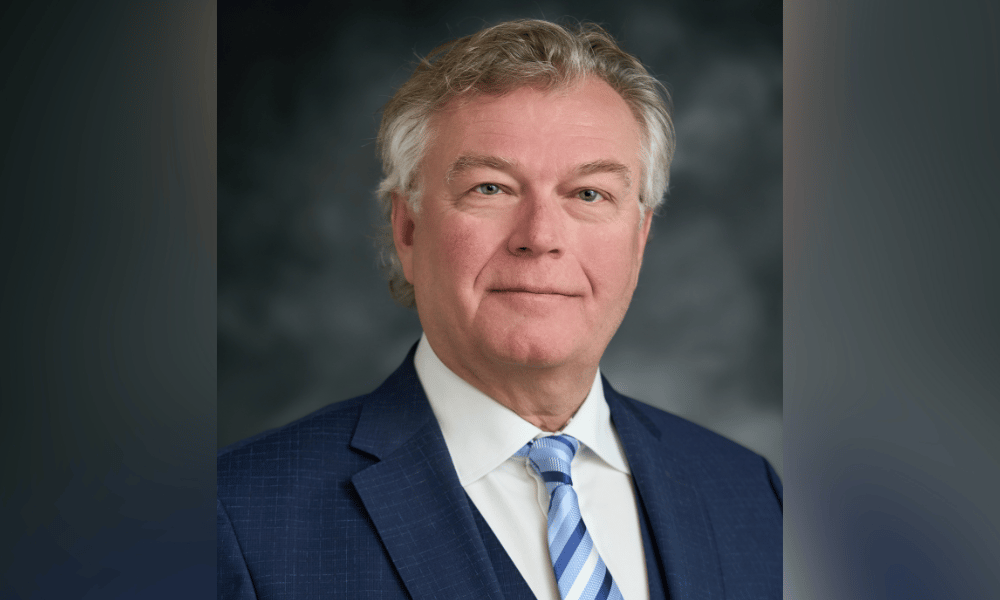
The in-house lawyer who reflexively says no is the wrong lawyer for the energy sector. "We look at ourselves as partners in the business as opposed to... the sales prevention team," says Don Bjornson, general counsel and corporate secretary at Manitoba Hydro. The clients showing up at his department's door aren't necessarily looking for legal opinions – they want workable solutions to their problems that sit at the intersection of law, business, technology, and sometimes politics.
Bjornson has spent more than two decades building that ethos at Manitoba Hydro, where he oversees a legal team of 20 lawyers, a 36-person property department, insurance services, ethics and compliance, the privacy office and the market compliance office. The Crown corporation is Manitoba's only electricity and natural gas provider – a vertically integrated monopoly that generates, transmits, and distributes energy to Manitobans and exports power to other provinces and US states. It is also, Bjornson notes, operating in "an unprecedented time of change."
From private practice to general counsel
Bjornson was called to the bar in 1987 and spent 16 years in private practice at a midsize Winnipeg law firm, gravitating toward corporate and commercial work. Manitoba Hydro was among his clients – assisting in commercial and real property transactions and early energy files – and when the utility opened an in-house role in 2003, it offered something rare: a chance to specialize in electrical energy law. "In Manitoba, energy law is electrical energy law," he says. "There's still only a handful of us in the province who can say that they practise in energy law."



That specialization anchored his in-house career until 2021, when both the outgoing general counsel and the assistant general counsel retired. He applied, earned the role and has spent five years largely learning it on the job. "There's no school for general counsel as far as I'm aware," he says, "so you've got to learn as you go." Preparing the next generation of GC is now among his stated priorities. "You leave it better than you found it," he says.
A department built for a complex portfolio
Bjornson also serves as corporate secretary – a role historically combined with the GC position – advising the board, equipping board members to be wise leaders and overseeing all related administrative functions. If forced to divide his time, he says the GC work takes a slight edge, but the corporate secretary function is, in his words, "a fairly significant undertaking."
Internally, the team handles regulatory, labour, procurement, contracts, export transactions, market and transmission access, litigation and property matters. Manitoba Hydro is the province's second-largest landholder, making property issues substantial. Certain work goes to external counsel – US tax, US regulatory matters, large-scale litigation and most Indigenous law matters – but Bjornson favours an embedded model, placing an internal lawyer alongside external teams on major files to build capability. "Our goal... is to be able to do as much as we can internally," he says.
Electrification, regulation and the pressure on supply
The utility sector is in a period of transformation that shows no sign of slowing. Electrification is straining supply across the industry, and Manitoba Hydro – for all the advantages of a grid that is 97 percent hydraulic – is not immune. "When we move to increased electrification, every utility is discovering that they haven't got enough electricity to go around," Bjornson says. The utility is working through a Public Utilities Board process for its Integrated Resource Plan, mapping out future generation needs, with that approval and a major facilities approval currently pending. Wind capacity is part of the answer: the Manitoba government’s Affordable Energy Plan mandates Manitoba Hydro to add 600 megawatts of new wind energy through power purchase agreements, with proponents of those wind projects required to be majority Indigenous-owned.
The broader landscape adds further pressure – new technologies, shifting stakeholder relationships and increased regulation are all reshaping the legal function's workload. "We're constantly in the news for good and bad reasons," he says, "but often it's about how increasing financial pressures and emerging technologies are impacting the people we serve, and, as the monopoly energy provider, we're front and centre in that."
Reconciliation in practice
One of the most consequential files in the department is Indigenous relations. Bjornson is measured about the history. "We acknowledge the significant impacts that our projects and operations have had on the land and culture of Indigenous communities: generation construction decisions flooded land, disrupted traditional territories and affected the people’s spiritual connection with the land and their livelihoods. Reconciliation is one of Manitoba Hydro’s foundational values and reflects our commitment to Indigenous reconciliation in all aspects of our business.”
Manitoba Hydro was the first utility in Canada to partner with an Indigenous community on generation, developing the Wuskwatim Generating Station through a limited partnership with Nisichawayasihk Cree Nation, and has since applied a similar equity structure to a subsequent generation project, the Keeyask Generating Station. The majority Indigenous-owned wind mandate reflects that continued commitment.
The legal department navigates both collaborative and litigious relationships in this space. "We find ways to avoid the necessity for fights," he says. "And if you're in a fight, to do your best to resolve it."
The guardian and the business partner
The most persistent tension in Bjornson's work isn't regulatory – it's structural. The in-house lawyer is expected to be both a trusted business partner and, when necessary, the person who halts a course of action. "Sometimes you just got to say, we're not doing that," he says. That tension cannot be resolved – only managed within its parameters.
It surfaces most clearly in his role leading ethics and compliance, where he promotes what he calls a "culture of performance combined with integrity" – built on adherence to law, ethical standards and the corporation's core values.
For aspiring in-house lawyers, his advice is less about technical skill and more about orientation. "Learn the business," he says – not just by reading about it, but by immersing in it and seeking out files outside one's comfort zone. Crown governance adds its own dimension: the statutory relationship between Manitoba Hydro and the province, as its owner, differs materially from anything in private-sector corporate law, and adapting to it takes deliberate effort.
Don Bjornson is a member of the Canadian Lawyer Leaders Network.