

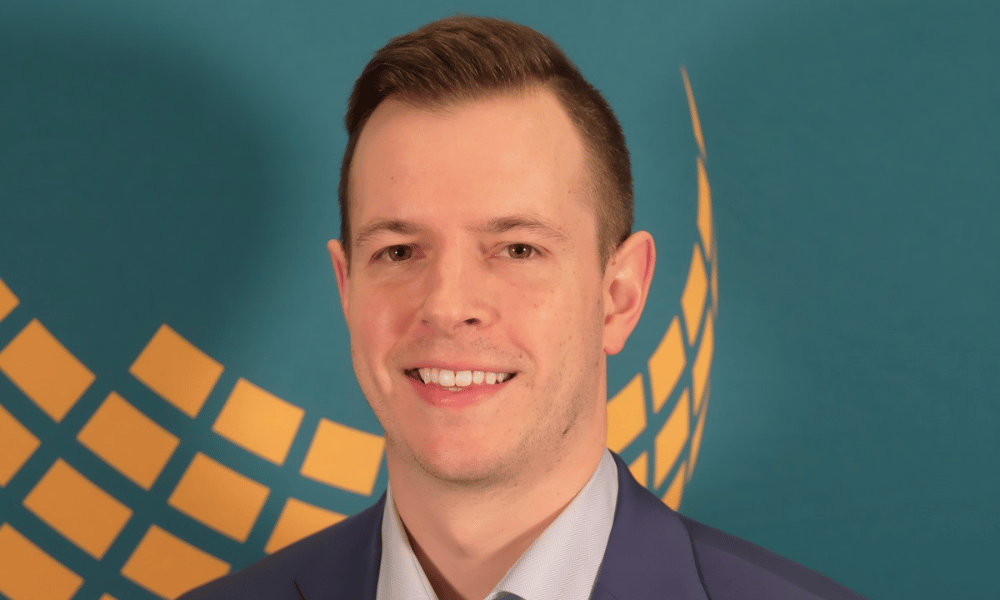
When Sander Lekas left a commercial practice at Reynolds Mirth Richards & Farmer LLP in 2021 to become the first lawyer at SkyFire Energy Inc., he was trading the relative stability of an established Edmonton firm for a solar company that had been operating for two decades without in-house legal counsel. No standard contract terms. No defined risk management process. No legal operations. No playbook. Active matters were already in motion.
"I had an itch to scratch, and I wasn't sure what it was," he says. I’ve always been drawn to puzzles and problems. What it turned out to be was the pull of building something from the ground up in a fast-moving industry, rather than dispensing parcelled-out legal advice from the outside.
As general counsel at SkyFire – which is one of Canada’s largest pure play solar engineering, procurement, construction, operation and maintenance companies, founded in 2001 with projects operating across eight provinces and territories – Lekas oversees all legal matters for a roughly 250-person organization. He is still the only lawyer on the team.


Building a legal function from zero
SkyFire was built by engineers, and the scale of what Lekas walked into on day one made that clear quickly. His first week included making submissions in a court proceeding while simultaneously negotiating a joint venture to pursue a contract for the 100 MWp TransCanada Energy Saddlebrook Solar project, ultimately delivered by the joint venture in 2023-2024.
"In my first week, I made submissions in a court proceeding," he says. The breadth of that workload never really narrowed. SkyFire delivers off-grid, residential, commercial, industrial, and utility-scale solar photovoltaic, battery energy storage, and operation and maintenance projects simultaneously. This meant building standard terms, overhauling contracts, establishing processes, and collaborating with SkyFire’s team to quickly understand and manage risk, all alongside an active deal flow.
His core mandate, as he defines it, is proactive risk management without restricting the business. With roughly 250 employees and one lawyer, the line between legal and business decisions is often thin and blurry compared to larger organizations, and the conversation about where to draw it tends to involve, at most, a few other decision-makers. “The trick is to understand when the business needs my input as a lawyer, when it needs my input as a problem-solver, and when it doesn’t need my input at all.”
Moving in-house also changed how he sees the work itself – "The projects are not just words in contracts," he says – a perspective shaped by watching people actually build what he papers: design work, field labour, equipment, scheduling, permits and approvals, procurement, and weather, all requiring coordination for a successful project delivery. It has pushed him toward a less prescriptive approach: available to solve problems, not to manage how they get solved.
Regulatory pressure and the ITC audit problem
"Project interconnection approvals specifically for solar are incredibly delayed in Alberta, up to 18 months for large behind-the-meter projects," says Lekas. "We used to see those approved in four to six months." Interconnection approvals for front-of-the-meter projects are even longer. Beyond those delays, Canada's clean energy Investment Tax Credit (ITC) – which provides up to 30 percent of capital costs on qualifying projects – has created a challenge that Lekas didn't anticipate when the program launched. SkyFire's clients have been benefiting from the ITC, but the audit process arrived without adequate clarity from the CRA on certain criteria.
"We've got a very happy client until they get the email everybody was expecting that they're being audited," he says. "And of course, that creates concerns and uncertainty." What the ITC will ultimately require of project proponents in terms of documentation and eligibility remains imprecise enough that navigating the first audit cycle is itself an exercise in managing expectations under uncertainty.
The broader regulatory picture reflects a structural mismatch. "We have this highly flexible common law system. We produce these very inflexible regulations, and then we're told, ‘go do good with your business,’" he says. On the flip side, there are also encouraging examples of progressive change, such as the BC Energy Regulator streamlining permitting requirements for utility-scale solar and wind projects under a new “one window” process. What he wants is not deregulation, but predictability – standards that apply consistently across provincial lines so that project approvals don't feel like a different exercise every time.
The Hakai acquisition and what comes next
In January 2026, SkyFire completed the acquisition of Hakai Energy Solutions, a BC-based company specializing in solar, battery storage, microgrids, and off-grid systems. Post-acquisition, the combined organization spans six locations across Alberta, mainland British Columbia, and Vancouver Island as the companies work toward formal amalgamation. For Lekas, supporting the acquisition as the sole in-house lawyer meant being involved at every stage – from identifying goals and setting strategic objectives through financial and share-rollover negotiations, to supporting SkyFire’s due diligence and advising on key deal mechanics – before handing off the closing to his former firm.
"I still have the support of the same team at Reynolds Mirth Richards & Farmer that I've actually been a member of," he says of that arrangement. "It's really seamless for me to engage them. I know who's who and I have a high degree of trust in the lawyers and their quality of work." The acquisition strategy is unlikely to stop with Hakai. "We plan to keep growing by acquiring and expanding across Canada," he says.
B Corp as an operating standard
SkyFire was a Certified B Corporation before Lekas joined. The certification required amending the articles of incorporation to embed a stated purpose beyond profit – to benefit people and the planet – backed by scoring against ethical and sustainability criteria. This isn’t merely a box-ticking exercise. "Down to the details in our contracts, it all has to be aligned with how we treat counterparties, how we treat our employees, how we operate in disputes," he says. As a wholly employee-owned business, SkyFire’s team is compelled to a higher standard of accountability at all levels and strives to use the business as a force for good.
The 25-year residential workmanship warranty SkyFire recently launched reflects the same philosophy: if something goes wrong, fix it rather than fight over it – a posture that Lekas, as the person who sees disputes when they arise, describes as genuine. SkyFire is, he believes, among the few pure-play solar companies in Canada with in-house legal counsel, a position that brings competitive visibility alongside the operational intensity of building an acquisition-driven national brand with one lawyer.
For lawyers weighing a similar move – joining a company without an existing legal function – his advice is to build the foundation in a firm first, developing the research, writing, and analytical skills that take sustained time to acquire. After that, learn directly from industry professionals within an established business. "You can only learn so much from other lawyers," he says.