

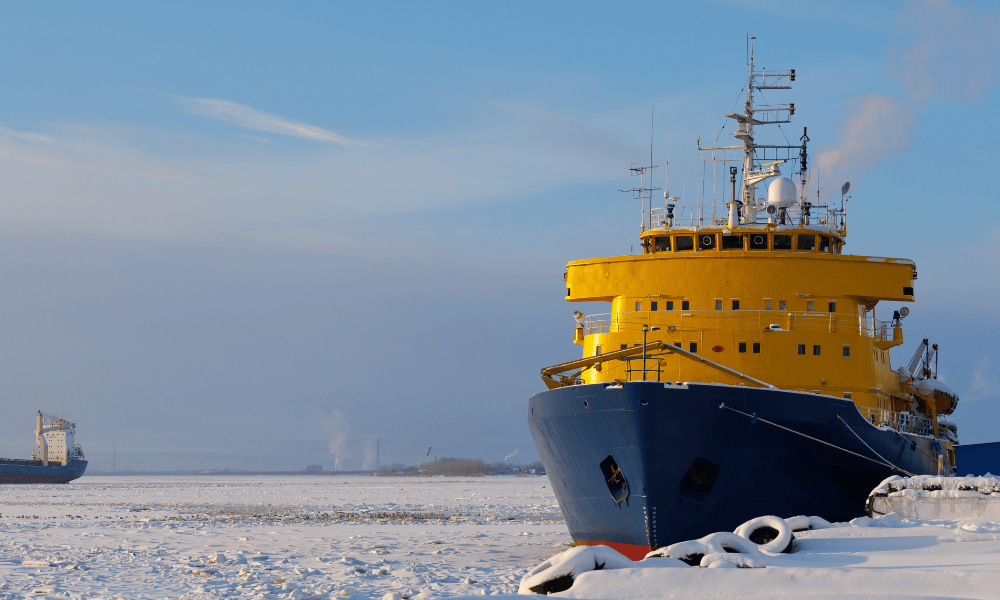
The federal government has announced that it will be investing over $11 billion into the construction of six program icebreakers to be used by the Canadian Coast Guard.
This is Québec’s biggest shipbuilding contract to date. According to the federal government, the investment will expand the country’s domestic shipbuilding industry, maintain access to key trade routes, and reinforce Canada’s strategic autonomy.
The Polar Class 3 icebreakers are to be designed as vessels that can navigate Canada’s waterways in various missions and under difficult ice conditions. They represent the next generation of Arctic-capable ships and will handle operational requirements in the north, including search and rescue and environmental response, Northern resupply, and Arctic science missions.



The new icebreakers will take the place of existing aging heavy and medium icebreakers, which are located in Atlantic Canada and the St. Lawrence through winter and in the Arctic during the summer. The government said in a press release that the icebreakers “cut open our most vital sea lanes, answer the call of ships in distress, and come to the aid of vessels trapped in the ice.”
Chantier Davie Canada Inc. has partnered with the federal government on this project. It has long worked with the CCG and the Royal Canadian Navy to construct, fix, and maintain ships across contracts valued at over $7.74 billion.
“As we shore up our economic sovereignty in a more unpredictable world, Canada continues to rely on trusted industrial partners like Chantier Davie. Their skilled workers here in Lévis are valued partners to the Government of Canada and have proven integral to the success of our Defence Industrial Strategy,” said Joël Lightbound, minister of government transformation, public works and procurement and Québec lieutenant, in a statement. “Today’s announcement of a contract for six program icebreakers builds on their strong record and will bring good-paying jobs throughout the supply chain, translating into real economic benefits in Québec and across the country.”
The contract also makes Canada the site of the biggest icebreaking fleet in NATO. The project is set to commence building next year, with the first ship expected to be operational after five years and the full fleet ready by 2038.
“Canada’s economic security and national sovereignty depend on our ability to keep our waters open, secure, and moving. These six new icebreakers will keep Canadian trade flowing, strengthen our presence in the Arctic, and give the Coast Guard the capability it needs for decades to come. Built here in Lévis, by Canadian workers and with Canadian steel, they are an investment in our sovereignty, our industrial strength, and our future,” said David J. McGuinty, national defence minister, in a statement.
The federal government first announced its procurement of six new program icebreakers under the National Shipbuilding Strategy in 2019, in line with the CCG fleet renewal. It inked the Icebreaker Collaboration Effort Pact in 2024 with the US and Finland to bolster cooperation on designing, building, and maintaining Arctic and polar icebreakers by sharing information, developing workforces, and collaborating on research and development.