


“Condo Market Dead!” screams the headlines. But is that true? This article explores that question, makes a few observations and draws some conclusions.
I set out to explore the Greater Toronto Area (GTA) condominium market during the period just before COVID-19, then throughout the pandemic and to date. This analysis examines the cost per square foot for condominiums in the GTA, using data largely drawn from developer marketing materials. I also reviewed the resale market for condos in buildings that are three years old or newer in the present market. Finally, I looked at the Census Metropolitan Area (CMA) population of the GTA.
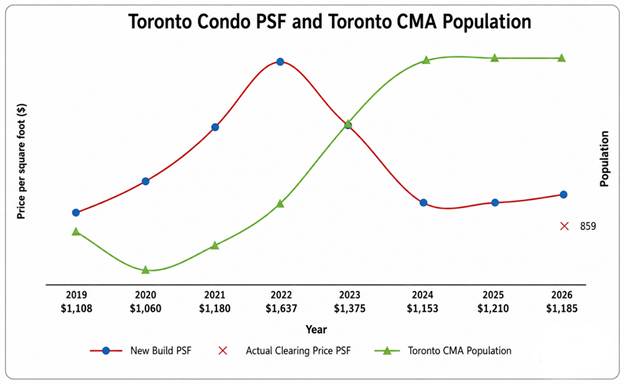
Below is the combined chart.


AI was used in the research for this paper. The facts were reviewed independently where possible and analysis was challenged, but much of this article is based on AI’s ability to analyse phenomena and predict behaviour based on its absorption of vast amounts of data. The results are interesting and instructive but remain speculative.
Immigration policy and interest rates
Before COVID-19, the Trudeau government had implemented an economic policy that relied on population increase through immigration to generate growth. This hit a bit of a snag with COVID-19 and numbers went down but quickly recovered, as indicated in the chart. Many Canadian newcomers came to the GTA. Having to address a significant influx of newcomers stressed all sectors of the economy, including housing.
In addition, during COVID-19, many people were working from home and had money, either from continued employment or from the federal government. With nothing to do but work at home, many decided that they needed a nicer place to live and work. This, together with dramatic population growth, led to a sharp increase in the cost of housing. The price of a condo in the GTA in 2019 was $1,108 per square foot. That rose to $1,637 in early 2022: a 48% increase in three years.
The federal government kept interest rates low to avoid economic shocks. There was some concern about housing price inflation, but policymakers signalled that they thought that housing prices were “realistic.” Then the Bank of Canada changed its mind and raised interest rates to quell inflation.
That interest rate increase sent a shock through the housing market and prices started to fall, down to $1,153 per square foot in 2024: a 30% drop in two years and only $45 more than it was in 2019. Put another way, a $1,000,000 condo purchased in 2019 would be worth $1,040,000 in 2024.
But these are developer prices. No doubt some condos sold for $1,637 per square foot or more in 2022, but not many are selling for $1,189 at this time. Research suggests that the market-clearing price is $859 per square foot in the one- and two-bedroom segment in the GTA. Sales are happening at that level for newer resale condos. There are rumours that developers are accepting prices that are lower than the cost of construction to raise cash.
Immigration was curtailed under the Trudeau government in 2023 and 2024, but the plan was to further increase immigration in the following years. The Carney government has shut that down. Perhaps PM Carney is thinking of the experience in the U.K., where unrestricted immigration led to the rise of racist sentiment. This fuelled Brexit, an unwise decision from an economic standpoint, and one which Carney was required to address as chairman of the Bank of England. He probably doesn’t want to do that again.
Whatever the reason, population growth is flat to negative, interest rates are moderate but still much higher than they were during the pandemic and condo prices in the GTA are $859 per square foot, a 22.5% drop from 2019 and a whopping 47.5% drop from 2022. This is not a good time to be a condo owner in Toronto, but it could well be a good time to buy, should you be so inclined.
There are, of course, other reasons for condo prices to fall: poor design, shoddy construction, very high maintenance and other fees among them. And there are many incentives in place to encourage construction of housing. The Ford government has committed to building 1.5-million homes by 2031 and there are incentives to do that from all three levels of government. But you cannot sell what people do not want to buy, and people simply do not want condos at current prices. Do we need more of them? The current state of the condo market would suggest not. Do we need 1.5-million more houses in this environment? That is a really difficult call.
Understanding the condo investment model
How did we get here? There are many reasons but among them was a widely held belief that housing prices could not go down. Many people put their savings into pre-purchasing condos. They assumed that they would be able to sell the right to purchase at today’s price to another party for a profit before the condo was finished.
Many people made good money with this strategy until the events outlined above occurred. Those that invested in 2021 and 2022 likely have not fared well. In that period, private investors made up 70% or more of the presales that are relied upon by financial institutions to provide construction loans for condos. These private investors were looking for properties that they would not be living in or which they felt could be rented to offset costs while the market inevitably rose.
Condo projects were designed to hit the investors’ target points: they had to be in good locations and relatively inexpensive.
The existence of so many private investors was a unique feature of condo development in Canada, along with high levels of leverage and low levels of cash required to secure financing. This tends to promote construction, and that is what happened.
DreamTower: A case study in investor risk
By way of illustration, consider a hypothetical condo tower with a great location in downtown Toronto (DreamTower). This property presold in 2021 and 2022, at the peak of the market, at prices between $1,600 and $1,750 per square foot. It is now in its construction phase and there remain units available in all categories. DreamTower has not sold out, and prices (from the developer) have gone up since inception to $1,800 per square foot. Prices are high, but it is a prestigious property. Private investors were a big part of the financing of DreamTower.
DreamTower is nearing completion so the investors will be required to fund the second tranche of their downpayment shortly. What will they do? At current prices, DreamTower is priced at 110% of the price of downtown condos in the resale market. It is also 52% over resale benchmark pricing. So, do the investors stay and double down on their investments, or do they walk away?
Based on market averages, presales in 2021 and 2022 would have been in the 70% range because that would have been a requirement for construction financing. Subsequent presales would have been slower so perhaps another 5% to 10% in 2023 and 2024 and little or nothing since. So DreamTower is 70% to 85% presold.
DreamTower is not panicking and does not offer discounts, but the financing model is generous. Purchasers needed to pay an initial 5% of the purchase price on making an offer and a further 5% on occupation. This is only 10% of the total (as opposed to a normal 20%), which means that the developer is quite exposed to investor defaults and investors have less to keep them interested. The developer has senior lender floating-rate financing for the construction phase, which would be fixed upon substantial completion and paid out from the closing of sales. There may be further levels of debt below the senior construction loan, each of which would be progressively more expensive. Leverage is traditionally very high.
Assuming that the investors are not walking away from their deposits, it looks like DreamTower is in good shape. If the analysis is correct, it has a fair margin to work with and should be able to weather the storm. However, the condo market is down a lot, and investors may prefer to walk away and take the loss (and the legal risk) of not purchasing. Investor default is not unknown in the GTA, so I decided to do a little modelling to see what it might look like for this project.
On the face of it, there is no real debate: economically speaking, the investor should walk. He or she only has 5% invested in a project that is extremely overpriced for the current market, so it makes no sense at all to continue. However, the investor has signed a contract, so the developer could sue to require the investor to make honour that commitment.
Would the developer do that? It depends on the level of defaults. If it is a very high percentage of purchasers, the cost would be prohibitive and take time. Is the developer able to support both litigation and continued construction?
Other factors include that DreamTower has great amenities and great views. Is that worth twice as much per square foot as available inventory? In addition, investors probably need to finance their investments. Can they afford or even arrange financing for these assets in this market?
I asked AI to do an analysis. The program made some assumptions and reported that, at this level of discrepancy, the balance of probabilities favours investors declining to participate further.
Getting back to our original question, the condo market has not bottomed out, but it is getting there. Perhaps $859 per square foot, or something close, is the floor. Unless the population increases, there is little need for further housing except for non-market purposes: low-income and distressed persons housing, for example. The federal government is already providing support for this sort of housing.
In the end, the market does not care what we planned to build. It cares what people want and are willing to pay. Right now, condos just don’t fit.
***
 Sam Billard is a partner at Aird & Berlis LLP in the Restructuring & Insolvency Group, which is among the largest in Canada, offering deep cross-border and cross-industry experience. Our work extends well beyond restructuring, encompassing all aspects of insolvency, enforcement, receiverships, liquidations, advisory work and dispute resolution.