


Canada has many of the ingredients needed to compete as a seat for international commercial arbitration: an independent judiciary, a stable legal system, experienced counsel and arbitrators, and a legislative framework familiar to international parties.
Canadian arbitration lawyers say those advantages deserve greater attention as businesses expand into new markets and look for reliable places to resolve cross-border disputes.
Luis Sarabia, a partner at Davies Ward Phillips & Vineberg LLP, says his own practice and the firm’s litigation group “are doing more international arbitrations than we used to do.”


Fasken Martineau DuMoulin LLP partner Rahat Godil, whose commercial disputes practice includes domestic and international arbitration, says she has also experienced growth.
“My sense is there certainly has been an uptick in international arbitration in Canada,” she says. Godil has been involved in multiple international arbitrations in recent years and says conversations with other Canadian practitioners suggest they have had similar experiences.
Dentons Canada LLP partner Rachel Howie, co-lead of the litigation and dispute resolution group in Canada and co-lead of the national alternative dispute resolution and arbitration group, says she has also heard increased market discussion about Canada as an arbitration venue.
But Scott Lucyk, partner at Lawson Lundell LLP in Vancouver and vice-chair of its International Chamber of Commerce Canada arbitration committee, says it may take time before increased interest in Canada becomes visible in the statistics.
That’s because the seat of an arbitration is typically chosen when parties negotiate their commercial contract – potentially years before a dispute arises.
“There’ll often be a two- to five-year lag between when a contract is signed – and decisions about the place of arbitration are baked into the arbitration agreement – and when a dispute may arise,” he says.
More than a meeting place
Godil says an important distinction is the difference between the “seat” of an arbitration and its physical venue.
“The arbitral seat really determines the procedural law that applies to the arbitration,” she says. The venue, by contrast, is where parties may meet for a hearing.
The distinction becomes important if courts need to become involved during an arbitration – for example, to issue an injunction or assist with the appointment of an arbitrator.
“The seat is more of a strategic decision,” Godil says.
When parties choose one, she says, they consider a host of factors, including neutrality, arbitration legislation, the approach of the courts, enforceability of awards, and practical considerations such as travel, cost, and facilities.
On all of those measures, she says, Canada offers significant advantages.
Rule of law provides foundation
Sarabia says foreign companies choosing Canada as the seat of arbitration can rely on a domestic legal framework governing related matters, including appeals, court intervention, and interim relief. Parties to an arbitration need to feel that matters will be handled “in a predictable and organized fashion [with]in a legal system that actually works,” he says.
“Canadian courts are seen as courts that are stable,” Lucyk says, pointing to Canada’s “rules-based, predictable institutions” and a judiciary insulated from political influence.
Howie says the combination of sophisticated courts and an arbitration-friendly legislative framework gives Canada an attractive foundation for international disputes.
“The judiciary in Canada is independent, with a strong commitment to the rule of law,” she says.
Godil agrees, saying Canadian courts support party autonomy, readily recognize and enforce awards, and generally support the arbitration process.
A familiar international framework
Howie points to Canada’s adoption of the UNCITRAL Model Law on International Commercial Arbitration, which provides international parties with a recognizable framework.
“We were actually the first country in the world to adopt the UNCITRAL Model Law back in the 1980s,” she says. That history can provide “a sense of familiarity to parties and entities from other countries.”
Lucyk says Canada’s history with the Model Law has also produced jurisprudence interpreting and applying the framework.
“I think that alone ... gives people confidence that they will get fair treatment in Canadian courts if arbitration-related issues need to be decided in court.”
The lawyers also point to the New York Convention regarding arbitration and the ability to enforce awards internationally as an important component of Canada’s framework.
Sarabia says Canada’s participation in international enforcement frameworks provides greater certainty regarding the recognition and enforcement of awards.
Competing on cost without sacrificing quality
Canada’s appeal isn’t limited to its legal system. Cost can distinguish it from established arbitration centres such as London, New York, Paris, Singapore, and Hong Kong.
Sarabia argues that Canadian counsel offer international clients a strong value proposition.
“We compete with American law firms and UK law firms for that work, and our costs are vastly less than those US firms,” he says.
“Our skill level is equal to or greater than many of the best arbitration counsel in those countries.”
Godil makes a similar point.
“Overall, I think Canada typically tends to be a more cost-effective jurisdiction,” she says, particularly compared with New York or London.
Those savings can extend beyond legal fees to arbitrators, hearing facilities, travel, and accommodation.
“You’re not compromising on quality when you come to Canada,” Godil says. Canadian arbitrators, practitioners, courts, and facilities, she adds, are “second to none.”
Howie also cites legal fees, hearing costs, the Canadian dollar, and accommodation as further advantages.
“We have world-class dedicated hearing facilities that are comparable to what you would find in other jurisdictions,” she says.
Lucyk is somewhat more cautious about treating cost as Canada’s principal selling point, but agrees that legal fees and other expenses can be lower than in cities such as New York, London, and Hong Kong.
Geography, technology, and two legal traditions
Canada’s geography provides additional flexibility.
With major cities spanning several time zones, parties can select a Canadian location suited to their commercial relationships. Howie says some cities can make it easier to work with Europe or across the Pacific Rim. In a 2024 survey on arbitration in Canada conducted by FTI Consulting, counsel recommended Toronto as the first-choice arbitration seat, followed by Vancouver, Calgary, Montreal, and Ottawa.
Lucyk describes the advantage as “optionality.” Vancouver, for example, may make sense for Asian parties doing business in North America.
Technology has increased that flexibility. Virtual procedural conferences and shorter applications have become increasingly common, even where the main merits hearing remains in person.
Sarabia says virtual proceedings can also accelerate the process. An interim dispute that once required arbitrators and counsel to coordinate travel could take months to organize. Virtually, it may be possible within weeks.
“You can’t get past the efficiency and the cost-effectiveness of doing something virtually,” he says.
Canada has another distinguishing characteristic: its combination of common law and civil law traditions.
Howie says access to practitioners, counsel, and arbitrators from both backgrounds helps Canada bridge legal cultures.
“We do offer flexibility and have skilled practitioners from diverse legal traditions,” she says.
Lucyk says Canada’s bi-jural character can be particularly useful for parties from civil law jurisdictions considering Montreal or Quebec City.
“We are bi-jural by nature,” he says, “and that makes us unique” compared with some competing options.
A reputation that needs promoting
Canada also benefits from an established community of internationally recognized arbitration practitioners.
Howie says prominent Canadian arbitrators have participated in the international arbitration community for decades, helping Canada develop a robust arbitration bar. That depth of experience, she says, gives international parties confidence in the Canadian arbitration community and the practitioners available to handle complex disputes.
Lucyk says Canadian practitioners can be found working at the highest levels in major arbitration centres around the world.
“Canadian arbitrators are generally well respected internationally,” he says.
Sarabia argues Canada’s broader reputation can itself be an advantage when parties are searching for neutral ground.
“The perception of Canadian neutrality is huge,” he says.
Godil similarly points to Canada’s reputation for “fairness, neutrality, and diversity” and says the current international environment presents an opportunity.
“I think Canada is definitely more attractive in the current global climate,” she says, adding that recent conditions offer an opportune time to promote Canada internationally.
That opportunity could grow as Canadian companies look to diversify their international business relationships away from the United States.
Howie says, “As Canadian businesses expand into a broader range of markets, opportunities are likely to increase for arbitrators and for law firms involved in international disputes.”
“We will probably see the international arbitration work kind of diversify following the diversified trade,” says Lucyk.
But promoting Canada cannot simply be directed at foreign companies, Lucyk says. Canadian businesses and their transactional lawyers also have a role when negotiating contracts. Where circumstances permit, they can put Canada forward as the seat for resolving future disputes.
“The change needs to start at home,” he says, “as well as also just by getting our message out to people outside the country.”
For Sarabia, Canada already possesses the fundamental ingredients.
“I think Canada is so well placed for all the reasons we’ve discussed to compete internationally on arbitrations,” he says. “We just have to continue to push our own merits.”
Lawyers’ recommendations on Canadian cities as the seat of arbitration
If you suggested a seat in Canada, which city did you most commonly recommend?
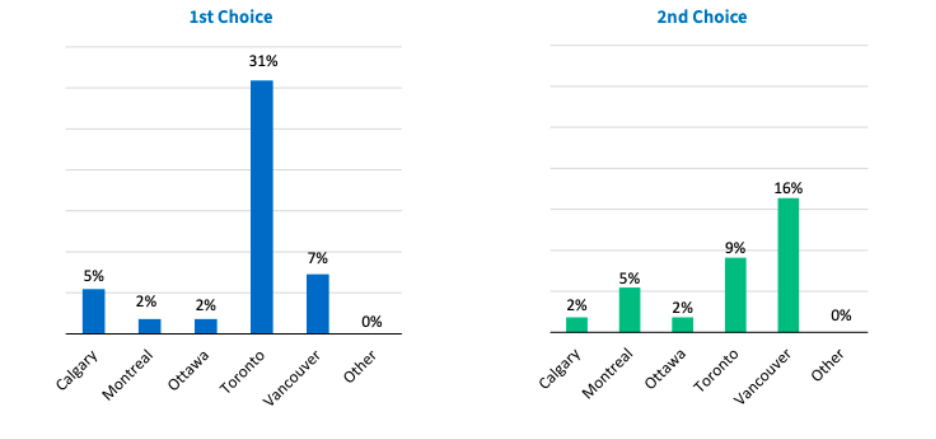
Source: FTI Consulting Canadian Arbitration Report, 2024